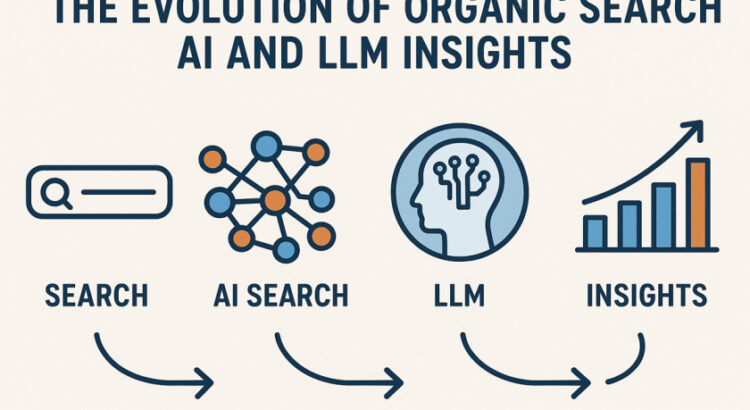




The Evolution of Organic Search AI and LLM Insights

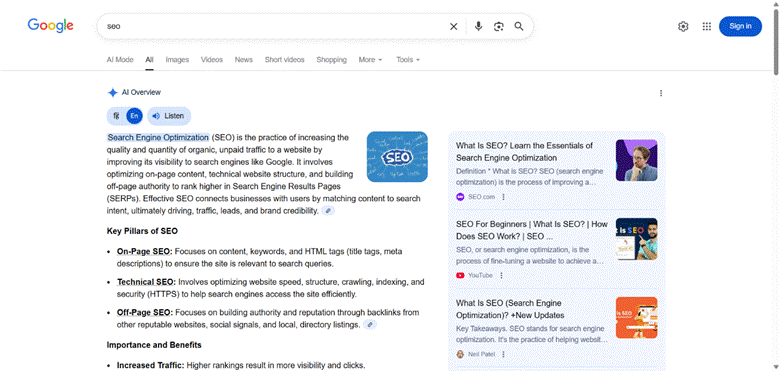
“Organic search” is a term used for results or listings that appear organically on a search engine result page and that are not paid for.

Apparently, some businesses run paid or pay-per-click campaigns that make their websites appear above the search listings; these lists in the search results are called paid search results or search engine ads. Both organic search results and paid research results work differently and, to some extent, serve different purposes for the marketer.

What is Organic Search?

It is the SEO strategies, applied by a business, that get their website appear on the SERP organically or naturally. The better you optimize your pages, the higher they appear in search results.

Search engines, like Google, Yahoo, Bing, and others, use complex algorithms to list websites in search results on the basis of a few factors. For example:

  • How relevant is a website or page for the user’s search query?
  • What value does the page offer to the user? Does the page offer any resolution to the user’s query?
  • Does a page have high-quality backlinks? What is the domain authority of the page?

Of these, the most important factor is relevance. If the bots or crawlers sent by the search engine sense that your website is relevant to the user’s search query, it will show up in the organic search listings. You technically don’t pay a penny to the search engine for getting a rank or position on the SERP, or search engine result page.

Read More

The Future of SEO Marketing Isn’t Humans vs AI- It’s Humans with AI

Several business owners have lately observed their website traffic going down. Around 60% of searches today don’t end up in a click. Why? Because people receive answers from AI. As soon as one puts up a query, you’ll get AI-generated, accurate answers. Thus, one may not need to visit the website either.

Don’t be worried. The good news is, the AI that is probably killing your business’s traffic will also help to drive growth. When AI and SEO work together, it can drive wonders. SEO isn’t only about keywords, algorithms, and rankings. It’s about building trust. It’s about strategy and social much more.

SEO Marketing in the Age of AI

With the coming of AI, the customer search behaviour is changing significantly. Well, Google has been weaving AI into its search algorithm for a very long time. RankBrain can easily interpret content, while BERT helps search engines understand language’s context better.

Despite all this, a significant question remains: Is SEO relevant in the age of AI? Well, sure it is. You may come across headlines that say AI will replace SEO or SEO is dead, but don’t just believe them. SEO is not dead; it is evolving. AI will only improve the process. Many are calling it Adaptive SEO.

Read More

SEO Trends to Watch in 2026: What’s Changing (and How to Stay Ahead)

SEO is one of the most dynamic fields. Managing the changes and updates can often be tricky for online businesses. It is incredibly crucial to stay informed about the latest SEO trends. Why? That’s one of the key ways to stay ahead in the industry. It also plays a vital role in beating your competitors.

With 2026 being just around the corner, there have been a lot of advancements in SEO lately. It is anticipated that the global market for SEO would reach $143.9 billion by 2030. Building an SEO strategy in 2026 would mean having discipline and something that will cut through the noise. But with all AI things going on, will SEO be relevant in 2026?

Will SEO Be Relevant in 2026?

Yes, very much. SEO will still be relevant and practical in 2026. There are around 99,000 searches on Google per second, even in 2025.

From keywords to backlinks, everything will be of utmost importance. Technical SEO, on-page SEO and every other component of SEO will be relevant and valid in 2026.

So, if you’re worried about what to do ahead, you need to refine the strategies. The sentiment of your target audience may have changed. However, the effectiveness of SEO is still very relevant. Many people are also looking into ways to hack into new strategies. If you do it the right way, that could play in your favour.

Read More

How to Optimize ASO for the Future of App Discovery

Today, the way applications and games are optimized or the way ASO (App Store Optimization) works has changed significantly. If you want to stand out in this competitive world, then you need to build a research-backed strategy that enhances the visibility of your app on the Google Play Store or the Apple App Store.

Did you know that nearly 63% of applications are discovered through app store searches?

App Store Optimization is a procedure that helps enhance the visibility of an app on the app store. As most businesses are adopting mobile-first approaches, ASO has become a necessity, not an option. With advancements in AI, online marketers and web developers can now more effectively devise the right strategies.

Img reference – Businessofapps

Let’s have a look at what ASO is and how to optimize it for the future app discovery: –

Read More

E-commerce Conversion Rate Optimization Statistics You Needto Know in 2026

As per Forbes, it is assumed that 24% of purchases are expected to be made online by the year 2026, along with ecommerce sales forecast to grow over 10% this year.

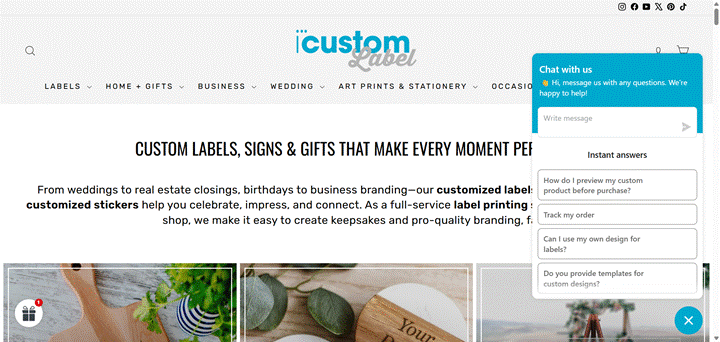
As stiff competition in the e-commerce industry will continue in 2026, CRO (conversion rate optimization) remains the most powerful lever for boosting the company’s revenue without significant spending on campaigns. Companies like iCustomLabel.com are investing in digital performance and user experience, and the standards for a high-converting online store are growing at a fast pace. By the end of this year, every eCommerce business should have an idea about the latest CRO statistics and benchmarks to stand out in today’s competitive market and improve profitability.

What Do Average Conversion Rates Look Like?

1. Global Average E-commerce CRO – When we talk about the
overall average, it is expected to remain steady in the range of 2.5%
to 3.5%. However, major brands may see conversion rates ranging
from 5% to 10%.

Read More